
The experience of home learning in recent years has left a valuable lesson for the educational world. Many schools have come to realise that face-to-face learning is irreplaceable, yet online learning also possesses distinct advantages that would be a shame to abandon. It is from this realisation that hybrid learning has gained its footing: combining the merits of both into a well-planned design.
Hybrid learning is often misunderstood as merely a class that is partially conducted through a screen. In reality, this model demands meticulous planning. Without a mature design, hybrid learning merely becomes two separate activities running independently without reinforcing one another.
What Is Hybrid Learning
Hybrid learning, or blended learning, is an approach that integrates face-to-face activities at school with online learning activities, both synchronously (simultaneously at a designated time) and asynchronously (accessible at any time). Both components are designed to complement each other within a unified learning flow.
For instance, pupils study core concepts through videos and reading materials prior to the start of class. Face-to-face time is subsequently utilised for discussion, problem-solving, practical work, and receiving direct feedback from the teacher. In this manner, shared classroom time becomes far more valuable, as it is dedicated to activities that most require physical presence.
Advantages of Hybrid Learning
The first advantage is flexibility. Pupils can access learning materials outside lesson hours, review sections they have not yet understood, and learn at their own pace. This flexibility is exceptionally helpful when a pupil is unable to attend due to illness or other commitments.
The second advantage is personalisation. Data from digital learning activities, such as quiz results and assignment completion, helps teachers identify who requires additional guidance and who is ready to be challenged further. Teachers can thus deliver more targeted attention.
The third advantage is the development of independence. Learning in a hybrid manner trains pupils to manage their time, uphold responsibility, and take the initiative. These skills are invaluable for further education as well as the future workplace.
The fourth advantage is the richness of learning resources. Interactive multimedia, simulations, and other digital resources enable abstract concepts to be presented in a more concrete and engaging manner.
Challenges to Anticipate
Every learning model presents challenges, and hybrid learning is no exception. Disparities in access to devices and internet networks can affect the learning experience. Schools must ensure that the learning design does not disadvantage pupils with limited resources.
Another challenge lies in motivation and discipline. Self-directed learning requires self-awareness that is not always easy for children to master, particularly at younger age levels. It is here that the guiding role of teachers and parents becomes paramount.
Furthermore, there is the challenge of academic integrity. When a portion of assignments is completed outside direct supervision, the values of trustworthiness and integrity must be continuously instilled. Assessments should ideally be designed to evaluate genuine understanding rather than mere end results.
Upholding Etiquette and Character in Online Learning
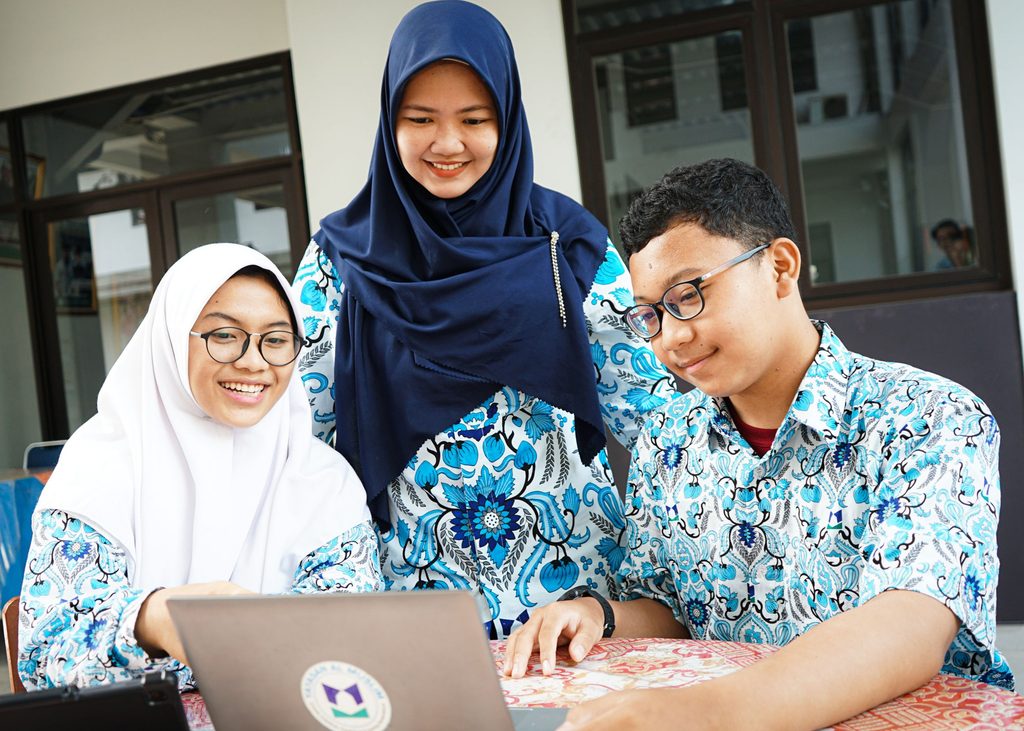
In Islamic education, knowledge is never divorced from proper etiquette (adab). Etiquette towards teachers, manners in seeking knowledge, and courtesy when interacting with peers are not rendered void simply because learning shifts to a screen. Pupils are still accustomed to commencing their studies with prayer, listening intently, speaking politely in online discussion boards, and dressing smartly during virtual meetings.
Teachers must likewise serve as role models in the digital realm. The manner in which a teacher greets pupils, responds to queries, and provides feedback on digital platforms serves as a character lesson no less powerful than explanations given at the front of the classroom.
Punctuality, honesty in completing tasks, and empathy towards peers facing difficulties are values that can be cultivated through hybrid activities, provided they are designed intentionally.
Practical Steps to Implement Effective Hybrid Learning
First, establish clear learning objectives, then determine which elements are best suited for face-to-face interaction and which are appropriate for online delivery. Avoid transferring everything to a platform simply because it is available.
Second, provide a simple and consistent learning flow. Pupils and parents will find it far easier to follow if content delivery patterns, assignment deadlines, and communication channels are kept uniform.
Third, provide regular feedback. Pupils need to know that their efforts are being noticed. Clear and constructive feedback maintains enthusiasm and guides continuous improvement.
Fourth, involve parents. Communicate how they can offer support at home, for instance, by preparing a quiet study space, limiting distractions, and assisting younger children.
Fifth, evaluate periodically. Gather feedback from teachers, pupils, and parents, and adapt the design accordingly. Good hybrid learning is that which undergoes continuous refinement.
Hybrid learning is not a shortcut; rather, it is a dedicated endeavour to enrich the learning experience. It requires teacher readiness, family support, and pupil commitment. When executed with sound planning and steadfast values, hybrid learning can serve as a vehicle to nurture a generation that is independent, digitally adept, and well-mannered.
Through Digislamic, Yayasan Al Muslim strives to deliver flexible learning without losing the essence of education: a warm relationship between teacher and pupil, and the continuous nurturing of moral character.